


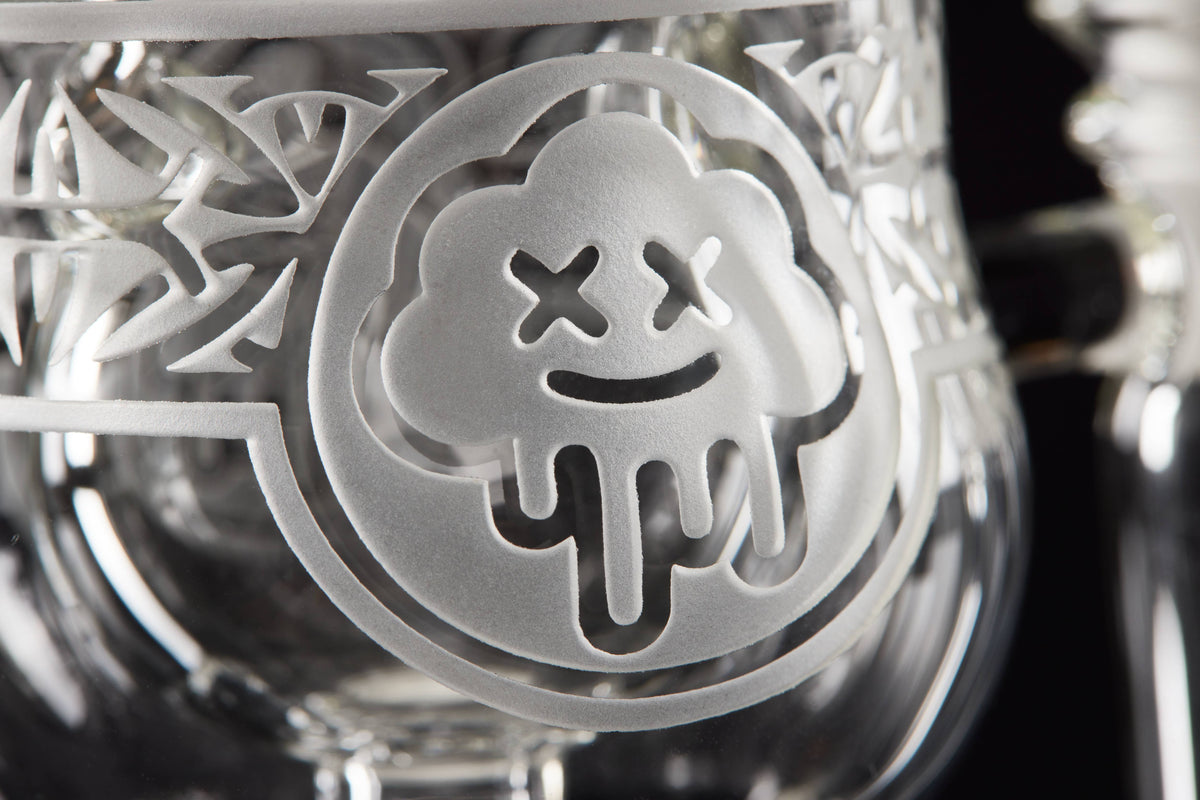

For a first traditional dab rig, start with a compact glass piece and a quartz bucket banger. It's a straightforward setup with fewer components to match and clean. If you'd rather skip the torch, an electronic rig (e-rig) gives you adjustable heat in one integrated system. Either way, look for comfortable airflow, parts that fit, and a setup you'll actually keep clean.
Good glass rewards a closer look. Joint placement, water path, and balance matter every time you reach for the piece, and the colorwork gives you another reason to reach. Here's how to choose a setup that earns its place in your ritual.
Step 1: choose between a traditional dab rig and an e-rig
The first decision is how you want to heat your setup: with a torch and a separate banger, or with an integrated electronic system.
Traditional dab rig

Product Featured: Cherry Blossom Mini Torus
A traditional dab rig pairs a glass body with a separate heating accessory, usually a quartz banger. With a torch-heated setup, you control the heat-up and cool-down yourself. A compatible temperature reader reduces guesswork by tracking the quartz surface, so you're not relying only on timing.
That hands-on control is the appeal. You choose the artist's glass, the banger, and the carb cap (which covers the banger opening to manage airflow and hold in heat), and you decide how they come together. The trade-off is a little homework, because joint size, accessory clearance, and cap fit all need to line up.
Mothership Glass's Cherry Blossom Mini Torus shows what to look for. The Jade Pink piece stands 6.4 inches tall, with a 10 mm female joint and a triple seed percolator (which breaks up airflow as it passes through water). Those numbers tell you more about its footprint and accessory fit than the word "mini" does.
E-rig

An e-rig builds the heating chamber, controls, and power source into one system. Depending on the model, you can pick from preset heat levels or dial in your own temperature and session length. Then you can repeat a setting you like with the press of a button.
Look past the heat-up time. Compare the controls you'll actually use, how the chamber cleans, what replacement parts cost, battery life, charging time, and whether key settings live in an app. A convenient session includes everything before and after the heat cycle.
There's also a middle path. An electronic nail (e-nail) pairs traditional glass with an electric heating element and a temperature controller, so you keep the artist's piece and drop the torch.
Choose traditional glass if picking components and managing heat are part of the pleasure. Choose an e-rig if integrated heating and repeatable settings suit your routine better.
Step 2: choose the right rig size
Height tells you whether a piece fits on the shelf. Chamber volume, joint placement, and the route through the glass tell you how it will feel during use. A tall, narrow design and a short, wide one can behave very differently from what their size labels suggest.
Small rigs

Product Featured: Eclipse Mini Ball Rig
A compact rig keeps everything within reach and takes up little room. Before you commit, check that the base stays steady with the banger attached and that the hot accessory clears the body and any decorative work. Small should still feel good in the hand.
The Eclipse Mini Ball Rig from Mothership Glass pairs borosilicate construction with a 10 mm joint and single seed percolator in a 7.5-inch piece. Royal Jelly and Plantphibian implosions place color inside the glass, creating the impression of forms suspended within it. That depth gives the eye somewhere to linger while the compact dimensions keep the setup close at hand.
Medium rigs

Product Featured: Dichro Day Tripper
A medium rig gives you more room around the mouthpiece and accessories while staying manageable on a table. Measure your space, then compare footprint and chamber shape. There's no standard size that guarantees a balanced draw.
The Dichro Day Tripper from 4.0 Glass stands 8–9 inches tall, with SCHOTT DURAN tubing, a four-hole percolator, and a choice of 10 mm or 14 mm joint. E. Ross makes and assembles the components, setting Alchemy Blues linework against Cyan Copper Dichroic glass. Dichroic glass shifts color as the light and viewing angle change, so the piece looks a little different every time you pick it up.
Large rigs

Product Featured: DD Halo RBR
A larger piece can offer more room for water movement, a different mouthpiece position, or an elaborate recycling system. It also asks for more table space and more time at the sink. Size it around where you'll use it and how comfortably you can handle it.
Bear Mountain Studios’ DD Halo RBR shows why the exact configuration matters. The 14 mm version stands approximately 12 inches tall, pairing Blurazz glass with sparkling Sunstone accents. Double diffusion adds a second stage of water interaction, while the halo drain forms part of the water’s return path. The listing also includes a separate 10 mm version, so check the selected option before matching accessories.
Which rig size is best?
For a first setup, go small or medium with a stable base. Step up to a larger piece when its mouthpiece position, water movement, or design genuinely suits you better. Either way, weigh chamber shape and accessory clearance alongside height.
Step 3: choose the right percolation
A percolator, or perc, breaks up airflow as it moves through water. Its openings and placement work with the water level and chamber shape to set the draw resistance and how the water moves. Counting chambers or holes won't tell you the whole story.
Give function videos the same attention as the colorwork: watch the piece at the maker's recommended fill level, see how the water moves and whether it reaches toward the mouthpiece, and note how it drains when airflow stops. If the listing doesn't mention draw resistance, ask.

Product Featured: Jaguar Tube
Functional details can carry an artist's signature, too. The Jaguar Tube, a collaboration between Pinky Brewtz and Darby Holm, incorporates an internal cactus percolator alongside the jaguar sculpt and peyote accent. The cactus brings the desert motif inside the working glass, carrying the collaboration through the water path as well as the silhouette. Watch its function to judge the draw.
Light percolation
A straightforward water path means fewer internal passages to fill and clean, which makes it a practical starting point. Fill level still matters, even in a simple piece.
Moderate percolation
A single showerhead (a tube capped with slits that split the airflow into streams) or a stemline (a horizontal tube with slits along its length) adds diffusion without several chambers to maintain. The openings, water level, and geometry set the draw, so function videos and maker guidance are your best read on the actual piece.
Heavy percolation
Multiple diffusion stages send water and airflow through more passages. That can suit people who prefer a more diffused draw, though the extra passages can add resistance and cleaning work. Recyclers are a separate choice: they add a circulation path that returns water to the main chamber, with or without heavy diffusion.
Which percolation style is best?
Start with a straightforward perc that's easy to fill and clean while you learn what you like in a draw. Once you know your preference, judge any piece by how it functions at its recommended water level.
Step 4: choose the right banger material
The rig body and heating surface do different jobs: the glass manages water and airflow, and the banger or electronic chamber handles heat. Choose a component built for your system first, then compare material, dimensions, and care.
Quartz

Product Featured: Hologram Quartz Banger
Quartz is a practical foundation for a traditional setup, with a broad range of designs, from open buckets to slurpers. Look closely at bucket dimensions, base thickness, the neck connection, and cap compatibility. Wall thickness and bucket shape also affect how a banger heats and cools.
Mothership Glass's Hologram Quartz Banger pairs a quartz heating surface with a decorative hologram finish. Its iridescent pattern shifts as the light moves. Choose the fitting first, then the pattern you want to live with.
Ceramic
Ceramic heating surfaces show up both as standalone accessories and inside e-rig chambers. Compare the specific component's heating system, dimensions, and care requirements. For an e-rig, stick to the manufacturer's approved chambers, since a similar-looking one may use a different connection.
Titanium
Titanium earns its place where durability matters, because it resists the breakage that can end a quartz banger's life. Buy a component made for your heating system and follow its care instructions. How long it holds heat depends on its thickness, its surface area, and the system it's paired with.
Which material is best?
For traditional glass, start with quartz, which offers a broad range of bucket and slurper designs. For an e-rig, use the chamber approved for your model. Beyond that, match material and design to your routine, because there's no universal heat-retention ranking.
Step 5: choose the right banger style
Banger design shapes airflow, cleaning access, and which accessories you'll need.
Bucket bangers

Product Featured: Moroccan Flame Polished
A bucket is an open heating chamber with direct access for cleaning, which makes it the natural first choice when you want fewer parts to manage. Pair it with a cap designed for the bucket's dimensions and airflow.
Toro Glass's Moroccan Flame Polished brings patterned quartz to the bucket format. Choose the joint configuration and a compatible cap around your rig, and let the finish give the setup its character.
Terp slurpers

Product Featured: Jumbo Terp Slurper
A slurper uses a lower dish and intake openings to pull material into its heated chamber during a draw. Marbles, pillars, or other inserts help steer the airflow and movement, which means more surfaces to clean and more dimensions to match.
Toro Glass's Jumbo Terp Slurper is handcrafted in Ithaca, New York, around a 40 mm quartz dish. A dish that size needs a clearance check alongside the joint fitting, especially on a compact piece. Confirm the joint configuration and matching accessories before pairing it with your glass.
Choose a slurper because you enjoy working with the design, not as a default upgrade. Use the maker's recommended accessory set, since caps and inserts from another banger may not fit the same way.
Blender bangers
Blender bangers use angled air intakes to set material spinning inside the heating chamber. Opening placement, chamber shape, and compatible inserts vary by maker, so look for a clear explanation of the specific design. Weigh the cleaning routine alongside the function.
Which banger style is best?
Start with a bucket for direct cleaning access and fewer accessories. Move to a slurper or blender when its airflow design appeals to you and you're ready to match and maintain the extra components.
Check the fit before you commit
A beautiful setup still needs its parts to meet properly. Run through these details before you choose accessories.
-
Joint size: Match the rig and accessory dimensions, such as 10 mm or 14 mm.
-
Joint type: A female joint accepts a matching male fitting; a male joint needs a matching female accessory.
-
Joint angle: Choose the appropriate angle, commonly 45° or 90°, so the heating chamber sits level with the rig upright.
-
Clearance and balance: Confirm the accessory clears the glass and sculptural details without making the setup unstable.
-
Cap and inserts: Match the specific banger design and dimensions. Check cap shape and insert clearances as well as diameter.
-
Included components: Check whether the banger, cap, inserts, case, or electronic chamber are included or sold separately.
For an e-rig, add replacement chamber availability, charging requirements, warranty coverage, and model-specific accessory compatibility to the list. For an e-nail, use the heating element, controller, and banger combination specified by the manufacturer.
Make room for the upkeep
Pick a cleaning routine you'll actually keep. Open chambers and accessible passages make inspection easy, while elaborate internal work calls for a closer read of the maker's care instructions. Ask how to clean delicate sculptural details and special finishes before you reach for a cleaner.
Electronic bases, removable glass, and heating chambers may each need different treatment. Follow the instructions for your exact model, including cooling, drying, and reassembly. Convenient heating still comes with maintenance.
Best dab rig recommendations by preference
Every rig leans into different strengths. Choose around the parts of a session you care about most, from flavor and airflow to cleanup and convenience.
Best dab rig for flavor
Start with a compact glass rig, a clean quartz banger, and a temperature reader. Choose a simple water path, and give heat control and upkeep the same attention as the glass.
Best dab rig for smooth vapor
Look at a medium-sized rig with moderate percolation and a draw that feels right to you. Watch function videos at the recommended water level and ask about resistance. More chambers change the experience, but they don't automatically make it more comfortable.
Best dab rig for beginners
Simplicity wins. Start with a stable, compact glass rig, a quartz bucket, a matching carb cap, and a temperature reader. If the torch is the part you'd rather skip, choose an e-rig with straightforward controls and easy-to-find replacement chambers.
Best dab rig for daily use
Look for a steady base, a comfortable mouthpiece position, and passages you can clean without turning it into a project. A small or medium rig with a straightforward perc and a quartz bucket makes a dependable daily setup. Budget for accessories and upkeep alongside the piece itself.
Best dab rig for convenience
Choose an e-rig whose heat settings, battery life, and chamber care fit your schedule. Integrated heating cuts out separate tools, and presets make it easy to repeat a setting you like. Check replacement chamber costs and availability before you settle on a model.
The right rig changes everything

Start with a stable footprint, comfortable airflow, and components that fit. Leave room in the budget for the cap, heating tools, and care supplies. Then take your time with the artist's work: the color choices, the shaping, and the details that make the piece unmistakably theirs.
Explore Headie's functional glass and accessories to find the combination you'll reach for every day. The good stuff deserves good design.
Share:
How to Dab Rosin Like a Pro: Best Dab Rigs, E-Rigs, and Quartz Bangers Explained
How to choose the right grinder: materials, size, and features