

Susie Silbert and The Long Argument for Glass
Curator Susie Silbert traces the culture, craft and working economy of American pipe making, and the decades-long effort to bring its history into museums.

The Long Argument for Glass
Susie Silbert has spent more than two decades documenting American pipe making as a complete artistic culture, with its own history, aesthetics, technical lineage and working economy.
When Susie Silbert first noticed glass pipes appearing around her high school in Chicago in the late 1990s, she placed them in a category with one other object.
The Starbucks to-go cup.
"There have only been two objects in the course of my short life, until this point, that didn't exist and were suddenly everywhere," Silbert recalled. "One of them was the Starbucks to-go cup, suddenly in everybody's hands. And the other was a glass pipe."
Silbert was already interested in craft and glass. What struck her was that one of these newly ubiquitous objects was handmade, often in the United States, at a moment when American manufacturing jobs were rapidly disappearing.
She was equally fascinated that young people who might never enter a gallery were willing to spend meaningful amounts of money on them.
Here was a handmade object that people used, collected, discussed and cared about. It had recognizable makers, evolving techniques and an audience capable of debating form, decoration and function in remarkable detail.
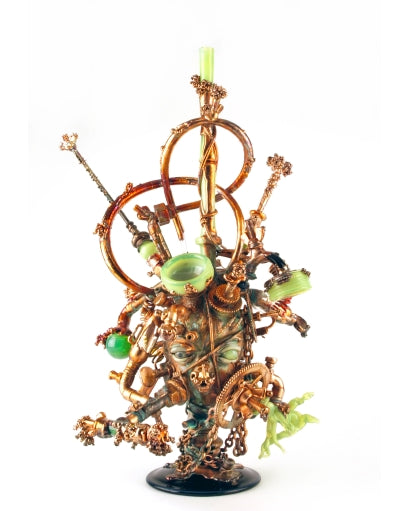
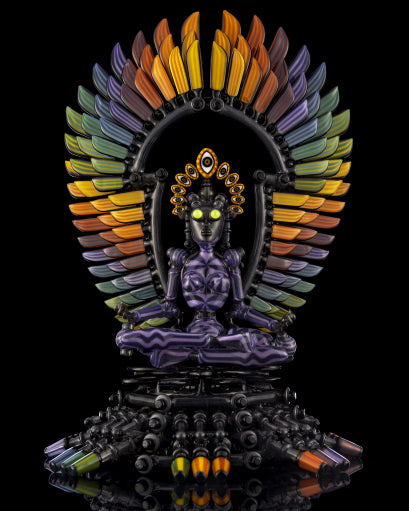
That act of noticing became the seed of Silbert's long relationship with American pipe making. It would eventually carry her through a career in museums and design history, into the glass cannabis-pipe acquisitions she made while at the Corning Museum of Glass, and toward High Style: The Art of Cannabis Pipes, an exhibition and book built from years of research and more than 100 extended conversations with artists, collectors, historians and members of the functional-glass community.
The exhibition was scheduled to open at the Toledo Museum of Art in 2026 before the museum canceled the project. The accompanying book is still moving forward, and Silbert says the research, structure and central ideas behind the exhibition remain viable for another institution.
The cancellation changed where the project would appear next. It did not end the larger work behind it: documenting American pipe making as a complete artistic culture, with its own history, aesthetics, technical knowledge, communities and working economy.
Twenty-five years of paying attention
Silbert's interest in pipe making predates the word "curator" in her own vocabulary.
Growing up in Chicago, she attended the SOFA art fair, where glass, ceramics, wood and other forms of fine craft were treated seriously. That background gave her a framework for looking closely at handmade objects before she had the language of design history or material culture to explain why they mattered.
At the University of Wisconsin–Madison, where she studied fine arts, Silbert noticed a strange divide. Inside her studio critiques, conversations about art could feel restrained. Outside those classrooms, people who would not have considered themselves "art people" could speak at length about the shape, decoration and performance of their pipes.
Geology majors, she remembered, could offer detailed observations about how a pipe's design contributed to its function.
To Silbert, the energy surrounding the work felt alive in a way that conventional distinctions between fine art, craft and functional objects did not fully explain.
By roughly 2001, she was already imagining what an exhibition of glass pipes could look like.
She later moved from studio practice into curatorial work, earned a master's degree in decorative arts and design history, worked in museums in Houston and New York, taught at the Rhode Island School of Design and became a curator at the Corning Museum of Glass.
When she interviewed at Corning in 2015, she proposed a pipe exhibition. The museum did not ultimately produce the show, but Silbert later acquired two glass cannabis pipes for its collection, in 2019 and 2021.
The first was David Colton's Untitled, Corning Museum, commissioned through the museum's Rakow Commission in 2019. Corning described it as the first glass cannabis pipe to enter an art museum's collection.
When the commission was announced, Silbert was already making the larger case that would eventually shape High Style.
"Pipes are one of the most important areas of glass production in the 21st century," she said at the time, citing their material and technical inventiveness, broad popular appeal and aesthetic possibilities.
She had also written about pipes for Glass Quarterly and begun imagining a book that would place American pipe making within a larger cultural and historical framework.
The exhibition that emerged years later was not the result of a curator discovering a newly fashionable subject. It was the culmination of decades spent watching an art form develop while most institutions paid little attention.
Bringing the culture in, not just the object
Silbert is direct about what she did not want High Style to become.
"What I didn't want to do was just take the pipes out of their cultural context and put them in the white walls of the museum and say, 'Look, now it's art; we're done,'" she said.
Her goal was to bring the culture into the exhibition with the objects.
For visitors unfamiliar with functional glass, she wanted the show to reveal an established field with experienced makers, significant technical knowledge and a sophisticated visual language.
She hoped they would understand that pipe making was neither temporary nor marginal within the lives of the people who built it. The objects in the exhibition would represent only the visible edge of a much larger world.
Silbert was equally concerned with how the exhibition would feel to the artists, collectors and community members who already knew that world intimately.
She wanted them to recognize pieces they had followed for years, encounter important works in person and see their own values and history treated seriously. She did not want the community's presence reduced to background information or removed to make the work more comfortable for traditional museum audiences.
"I wanted to not just bring the objects, but bring the people and the culture with it," Silbert said.
For her, the work, the makers, the collectors, the gatherings, the techniques and the social history surrounding them were part of the same story.
"The complete vision," she said, "is what I was after."
What legitimacy actually means
The idea of "legitimacy" follows almost every institutional conversation about glass pipes. Silbert approaches the term cautiously.
She does not believe every art form needs mainstream approval, or that recognition from museums automatically establishes the value of work that already matters deeply to artists and collectors.
What institutional recognition can provide, however, is access.
That can mean museum acquisitions, exhibitions, teaching opportunities, publications, scholarly attention and speaking engagements. It can place artists before audiences who might otherwise never encounter their work. It can also allow the work to be acknowledged directly, without curators disguising its function or slipping it into institutions through a side door.
When Silbert acquired a glass cannabis pipe at Corning, she wanted the museum to treat the moment openly. The acquisition was structured as a major commission and accompanied by public programming, press and documentation.
"It wasn't being snuck in the back door," she said.
That distinction is central to Silbert's argument. Institutional recognition does not create the artistic importance of pipe making. It can, however, give artists access to the front door and allow their work to be discussed on its own terms.
Silbert describes herself as a bridge builder, someone committed to helping people understand art forms and communities that sit outside their immediate experience.
The bridge runs both ways. Museums and scholars gain access to a rich field they have often overlooked. Artists gain opportunities without being asked to abandon the culture, use, or identity of the objects they make.
Playing Fifty
Silbert also knew that an exhibition of this scale could not simply become a selection of pipes one curator personally found impressive.
"I didn't want it to be an exhibition of just, like, pipes that Susie thinks are cool," she said.
Working with people from across the functional-glass community, she developed an initial list of roughly 200 artists. She then created an exercise she called "Playing Fifty."
Silbert sat down with artists, collectors and other knowledgeable participants and asked them to work through the larger list, identifying the 50 makers they considered most relevant.
She did not define relevance for them.
Some participants emphasized technical innovation. Others cared about influence, longevity, devotion to cannabis culture, personal values or qualities such as parenthood that repeatedly surfaced in the conversations.
The conversations could last several hours. As participants moved through the names, Silbert learned how people understood the field's history, which studios and gatherings mattered, how knowledge traveled and which values different parts of the community considered essential.
"Pipes are one of the most important areas of glass production in the 21st century."Susie Silbert
A group of roughly 20 artists emerged as a broad consensus. Other names appeared with different levels of frequency.
The exercise was not intended as a vote that would dictate the exhibition. It gave Silbert a clearer view of the field and helped her understand when her own curatorial decisions aligned with community consensus and when she was departing from it deliberately.
She describes the process as a community-responsive method of curating.
It required more time than selecting objects from a few major collections or assembling a personal list of favorites. It also produced an exhibition grounded in sustained listening.
Participants were allowed to speak anonymously, giving them room to discuss relationships, disagreements and histories more freely.
Silbert repeatedly returns to the generosity behind that process. People entrusted her with stories that had rarely been recorded and gave her hours, sometimes days, of their time.
The method demonstrates the scale of the project. High Style was not simply intended to display technically ambitious objects. It was designed to reflect how a community understood itself.
What it takes to make a living
Silbert's strongest measure of pipe making's importance may also be the most practical one.
Pipe makers have been able to build lives, and a living, around their work.
She has spent much of her career helping artists connect with galleries, museums and collectors. She knows how difficult it is to sustain a studio practice even when an artist works in a form that institutions already recognize.
Pipe makers faced the additional challenge of building careers around objects many people considered culturally suspect or artistically unworthy.
Despite that, the community created a working economy. Artists sold work, supported families, purchased homes, built studios and continued developing their techniques across decades.
Silbert sees that ability to sustain a life through art as a significant achievement.
"There has been no community of artists in glass that has been more successful in terms of building out a life and a career that sustains life," she said.
That economy is now under pressure. Silbert described the artisan pipe market as difficult at the same time that scholarly and institutional attention is growing.
Institutional recognition, meanwhile, moves slowly. Silbert first imagined this exhibition roughly 25 years ago and formally proposed versions of it more than a decade ago.
The gap matters because recognition has its greatest practical value while artists are still working.
Silbert does not suggest that one museum exhibition could repair an entire market. She does believe increased attention can create new audiences, new opportunities and new reasons for artists to continue.
The field itself remains unusually active across generations. Many foundational makers are still producing some of the strongest work of their careers, while younger artists can learn through classes, videos, studio networks and access to technical information that earlier generations had to develop through experimentation and small, informal groups.
The economic pressure on working artists is real, even as the artistic conversation continues to expand.
Where the exhibition stands
According to Silbert, High Style: The Art of Cannabis Pipes was being developed for an August 2026 opening at the Toledo Museum of Art.
Silbert saw Toledo as an especially meaningful setting because, as she put it, "Toledo is the birthplace of the American Studio Glass Movement." She pointed to the experimental workshops Harvey Littleton held on the museum's grounds in 1962, where artists began using glass in studios in a concerted way.
The museum later canceled the exhibition.
According to a TMA spokesperson, the decision to cancel wasn’t an easy one. “Toledo Museum of Art made the difficult decision to cancel the exhibition The Art of Cannabis Pipes, which was scheduled to open later this year. After a careful and thorough analysis of work taking place at the museum over the next 18 months, our Leadership Team came to the conclusion that some changes in the exhibition schedule were needed in order to prioritize staff wellbeing and workloads. This wasn’t a decision made lightly, and we remain committed to the scholarship behind the project including a catalogue that will be available in the fall.”
Silbert says the cancellation does not prevent the exhibition from being produced elsewhere.
A new institution would need to return to lenders and reconfirm individual works. Some objects might need to be replaced. But the research, curatorial structure, historical framework and relationships required to assemble the exhibition remain.
"The core idea, the core notions, the structure of the show and the thought behind the show is all there," she said.
She believes a future museum would gain more than the opportunity to present an underdocumented chapter of American art history. It would also gain access to a generation of artists and collectors who have invested in artwork and sustained a serious collecting culture with little institutional encouragement.
At a time when museums are searching for new audiences and supporters, the functional-glass community has already demonstrated that it cares deeply enough about art to collect it, preserve it, discuss it and build institutions of its own around it.
A record people can build upon
The book accompanying High Style carries the project beyond any single exhibition.
Silbert's contribution traces pipe making through cannabis history, the Grateful Dead, head shops, psychedelia, regional studio networks, early internet communities and the artists who passed techniques from one generation to another. Her essay ran roughly 3,000 words beyond its original limit, she said, with about 2,000 of those additional words ultimately retained.
The publication pairs scholarly contributions with recollections from artists, collectors and people who documented the community from within. Silbert presents her history as one account rather than a definitive one. Pipe making developed through overlapping regional scenes and personal relationships, often without a central archive. Depending on when and where someone entered the field, they could encounter an entire artistic world without knowing much about the worlds that preceded it.
Her account follows knowledge as it moved from artists like Bob Snodgrass into the generations and regional scenes that followed. It also captures moments when individual makers expanded the field's sense of what glass pipes could be.
Silbert points to Scott Deppe (of Mothership Glass) as one of those artists. After watching other pipe makers work, she said, Deppe "was able to do things that no one could imagine, and so quickly," helping change how people thought about the form.
The book also looks beyond studios and formal institutions to spaces where the culture developed and ideas circulated. Those include the Oregon Country Fair and Rainbow Gatherings, communal events with roots in countercultural and psychedelic traditions. In that context, the book discusses Banjo and the influence such environments had on the ways pipe makers approached their work.
This history traveled through people, studios, tours, gatherings, early publications and internet forums long before much of it entered a museum record. By gathering and cross-referencing those perspectives, the book gives future artists, curators and scholars something concrete to question, expand and revise.
An exhibition can be canceled. The history it was built to tell does not disappear with it.
Silbert believes High Style will find another home.
"I really think it will find its next audience," she said.
The exhibition lost its first home. The history behind it now has somewhere to live.